
Blast mitigation
Dramatically reduce blast impulse and heat release
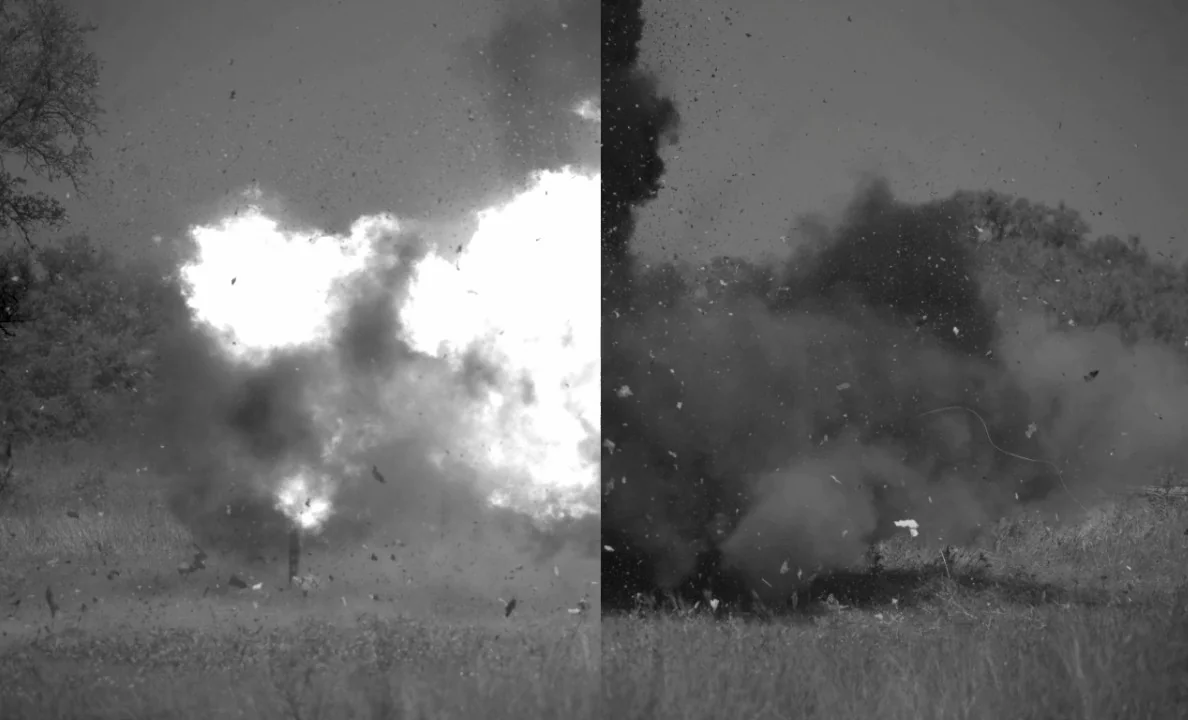
FPS containers and panels dramatically reduce blast impulse and heat release. This is new-to-the-world FPS blast mitigation technology: lightweight containers and panels filled with mitigating media that dissipate blast energy and suppress the fireball. Test data from Southwest Research Institute is in our presentation.
The objective
The objective of blast protection
Reduce blast impulse pressure, which includes reverberation and shrapnel. Suppress the fireball flame. Reduce heat release.
These are not new objectives for blast mitigation technology. What is new is the new-to-the-world FPS blast mitigation technology.
Why it is different
What makes this technology different
- Works in enclosed spaces such as buildings, vehicles and ships.
- Takes up little space.
- Made from readily available materials.
- No sophisticated manufacturing processes required.
- Easy to install with just hand tools.
- Low cost.
- Proven effective by multiple tests at an independent research institute.
The idea
Blast effect mitigation is not the same as blast resistance
Definitions
Blast impulse and blast effect mitigation
Blast impulse is:
- momentum transfer per unit area from blast waves into targets (bar-ms, Pa-s, psi-sec and so on);
- the area under the pressure-time curve of a blast wave;
- the mechanism that knocks down barriers, destroys vehicles and hurls people against walls.
Blast effect mitigation means:
- reducing impulse and peak pressure;
- reducing and suppressing heat release from detonations and deflagrations, which can prevent post-blast fires (“keep cool and carry on”).
What it does
What FPS containers and panels do
Why mitigate
Separation distances (Q/D)
In the US, regulations set separation distances (D) from explosive hazards (Q for quantity). Q is often called net TNT-equivalent charge weight (NEW) or NEQ.
D is based upon allowable pressures suitable for the situation: separation from public highways and communities, between explosives manufacturing facilities, between facilities on military bases and so on.
Q/D constraints limit where magazines, aircraft “bombing up” operations and even military units disembarking in ports (in peacetime) can be near urban areas.
Impulse is the proper criterion, but these regulations assume a linkage between peak pressure and impulse. It is crude, but pressure is easier to measure.
Bottom line: blast mitigation reduces the net effective Q (NEQ, NEW), which under Q/D regulations would greatly expand usable military base areas and allow safe operation of energetic material-handling operations near highways, ports and resources.
Bonus: blast-mitigating containers may allow Hazard Class 1.1 (“detonating”) materials to be reclassified as 1.4 (“insensitive”), substantially reducing limits on public roadway and railway transportation use.
Why mitigate
Confined spaces
Confining blasts inside structures (buildings, ships, magazines) is limited to small charge weights (Q, NEQ, NEW) because pressure and impulse cause structural failure.
Venting helps, which allows confinement of somewhat larger NEQ. But blast pressure and impulse build up faster than vents can relieve them, because of the distance from vents, the time delay before they open and choked flow in ducts that limits vent effectiveness.
Venting is not possible inside ships and submarines, inside large buildings or inside mines.
Blast mitigation inside ships, submarines, structures and mines is possible without venting, through exploitation of irreversible processes. Venting does help when it can be used.
How it works
Dissipating blast energy and momentum
Reducing peak pressure is often easy. Reducing blast impulse is difficult.
Sir Isaac Newton was right: total energy and total momentum are conserved (reversible processes) when two masses collide. Pressure is reduced and velocity increases as fluids pass through nozzles and screens. Pressure recovers and velocity drops as the fluid passes into the surroundings (ambient conditions).
But friction, viscous drag and heat transfer (irreversible energy and momentum processes) extract energy and momentum from the fluid. Blast impulse reduction is possible through the artful use of every possible combination of irreversible processes and mechanisms.
Mechanisms for rapidly dissipating blast energy and momentum in granular media:
- Multitudinous collisions between granules disperse momentum.
- Phase change materials (PCMs) absorb energy (kJ) through the enthalpy of fusion or decomposition (ΔHm, kJ/kg).
- Aerodynamic drag [proportional to (velocity)²] due to huge specific surface area.
- Heat transfer from hot gas to granular media due to huge specific surface area.
- Interference heating (in gas flow velocity above Mach 8).*
*Interference heating is the breakdown of the boundary layer due to turbulent flow and shock wave interactions. Heat transfer across the boundary layer increases about tenfold.
Test evidence
UK MoD DERA (now dstl) 1996 tests
200 g C-4 spherical charges detonating in 51 cm × 51 cm × 51 cm boxes.
| Shot and filler or panel | Form | Incident pressure average (kPa) | Impulse average (Pa·s) | Pressure reduction (P / CONWEP P) | Impulse reduction (I / CONWEP I) |
|---|---|---|---|---|---|
| DERA predicted* | Free air | 326.4 | 73.0 | – | – |
| 2: Perlite-filled | Box | < 35.2** | No result | No result | No result |
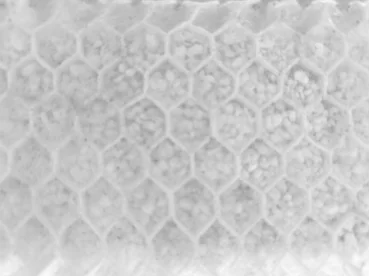
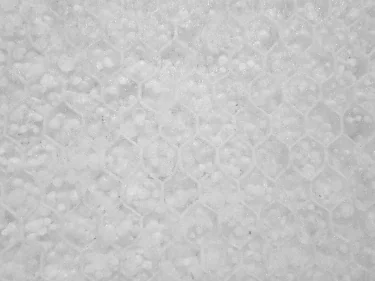
| 3: Perlite-filled | Panels*** | 39.7 | 30.0 | 87.8% | 58.1% |
| 4: Foam bead-filled | Box | 81.5 | 33.1 | 75.0% | 54.7% |
| 5: Foam bead-filled | Panels*** | 133.8 | 46.4 | 59.0% | 36.4% |
Test evidence
Recent research, 2024 to 2026
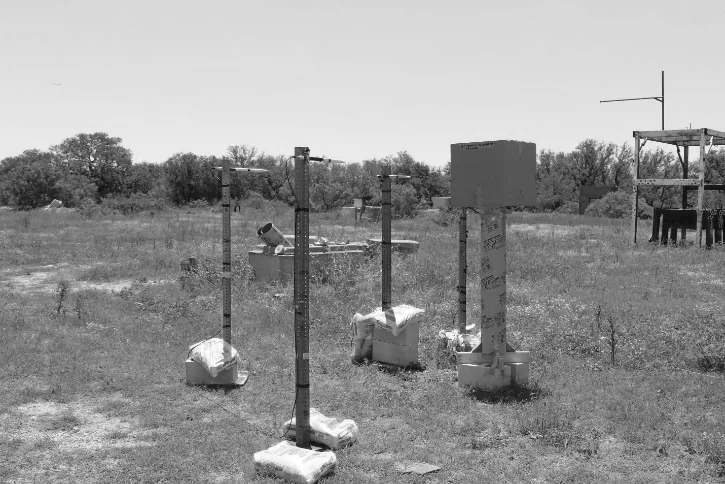
Adapting the DERA/dstl test setup and protocol, Southwest Research Institute (SwRI) conducted three test series using mitigating media in (a) panels and (b) granular media-filled cylinders surrounding the charges.
- Bare cylindrical C-4 charges were used in all tests, from 200 g to 600 g, mounted in the geometric center of each box.
- Single-wall corrugated kraft boxes, all 51 cm × 51 cm × 51 cm, were mounted atop a 150 cm cardboard tube, to record pressure data without reflected shock influence.
- Pressure transducers were placed at 1 m and 2 m from the charge surfaces.
- High-speed video with still photo captures.
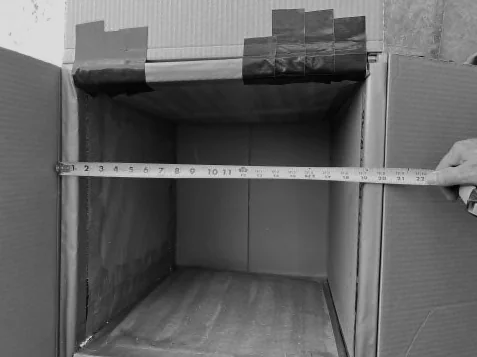
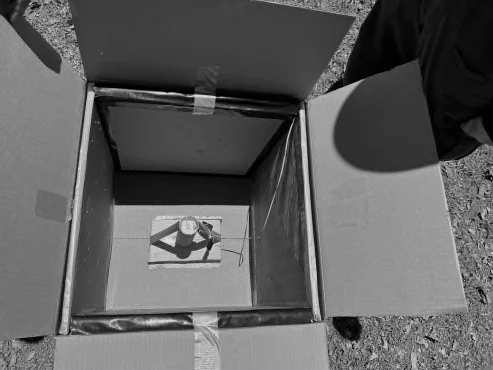
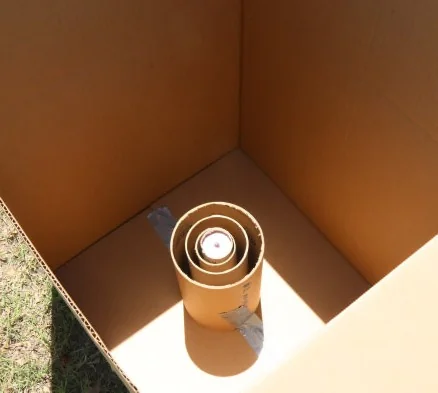
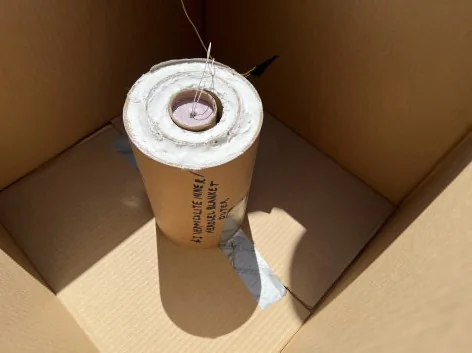
2026 test results
600 g C-4 cylindrical charges. SwRI-computed mitigation for different configurations. Shot 8 was the baseline.
| Configuration* | Tubes / panels | Filler mass (g) | Impulse** at 1 m (Pa·s) | Impulse** at 2 m (Pa·s) |
|---|---|---|---|---|
| V (front) / MT (back) | Tubes | 723 | 111.7 | 69.0 |
| V (front) / MT (back) | Panels | 1,393 | 140.7 | 60.0 |
| V (front) / lactate (back) | Tubes | 2,029 | 53.1 | 57.2 |
| V (front) / PCM (back) | Tubes | 1,781 | 72.4 | 57.2 |
| V (front) / aerogel (back) | Tubes | 856 | 111.7 | 73.1 |
| Vermiculite (17.5 cm) | Tubes | 1,571 | 75.2 | 63.5 |
| Foam beads (17.5 cm) | Tubes | 547 | 131.7 | 70.3 |
| CONWEP (600 g C-4) | Free air | 0 | 149.0 | 77.9 |
| Perlite 4.3 cm (200 g C-4) | Panels | 3,250 | 33.6 | N/A |
| Foam beads 3.8 cm | Panels | 217 | 8.0 | N/A |
| DERA predicted*** | Free air | 0 | 73.0 | N/A |
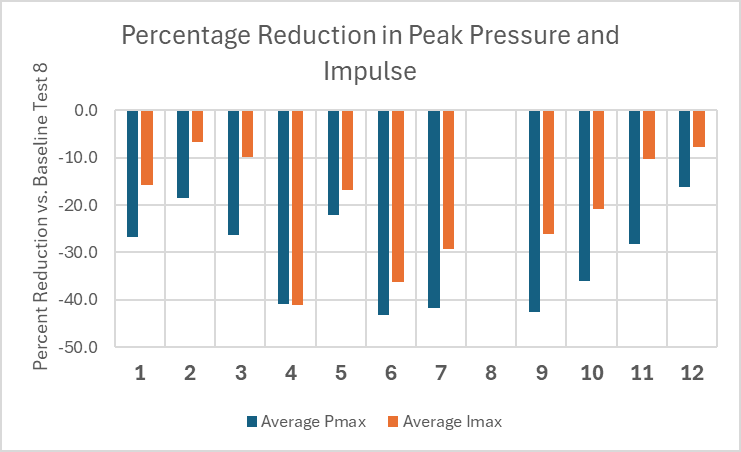
Test photographs
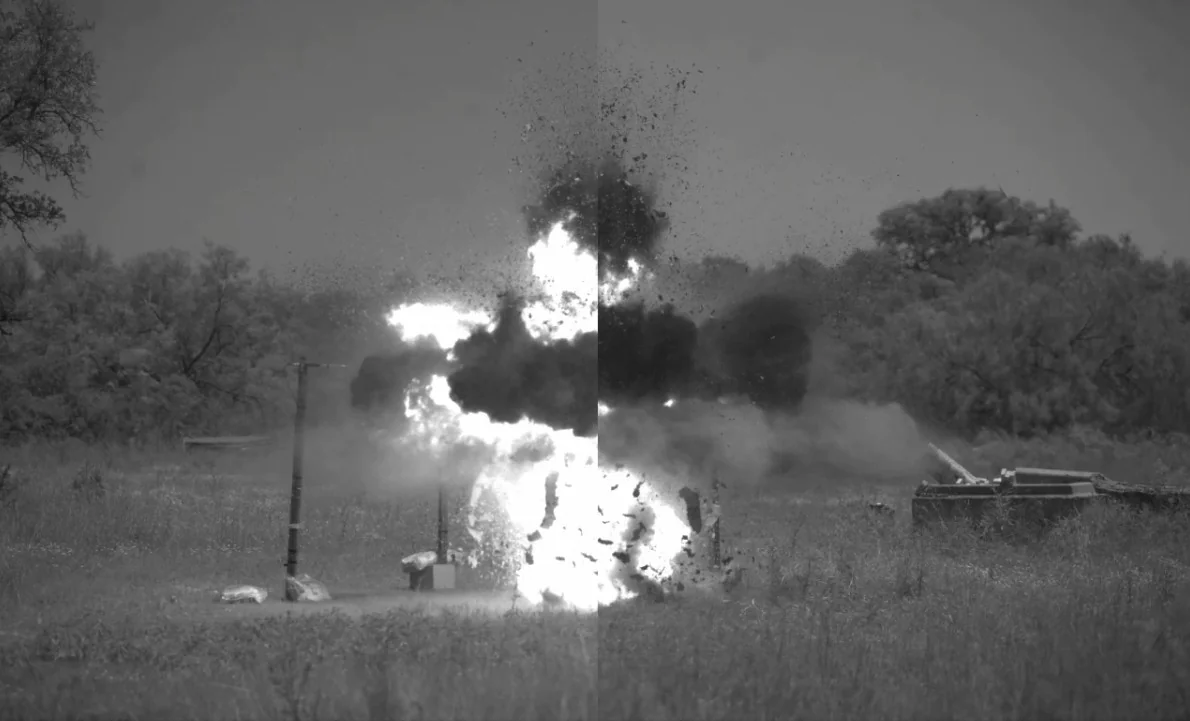
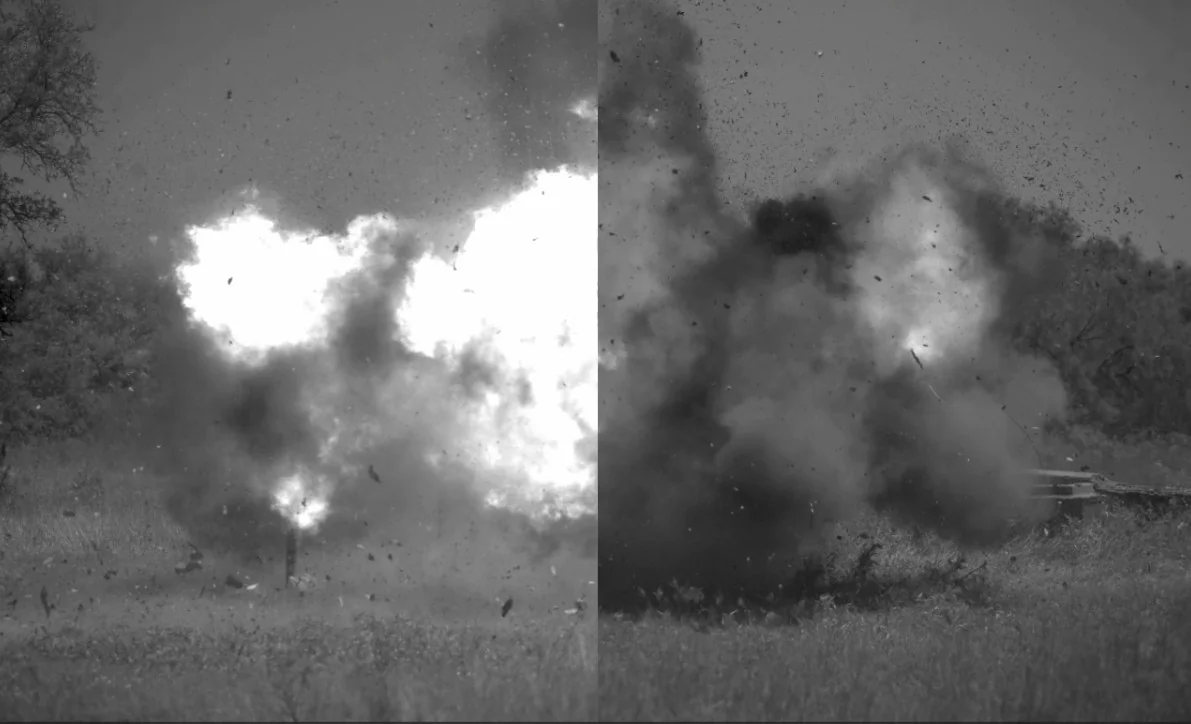
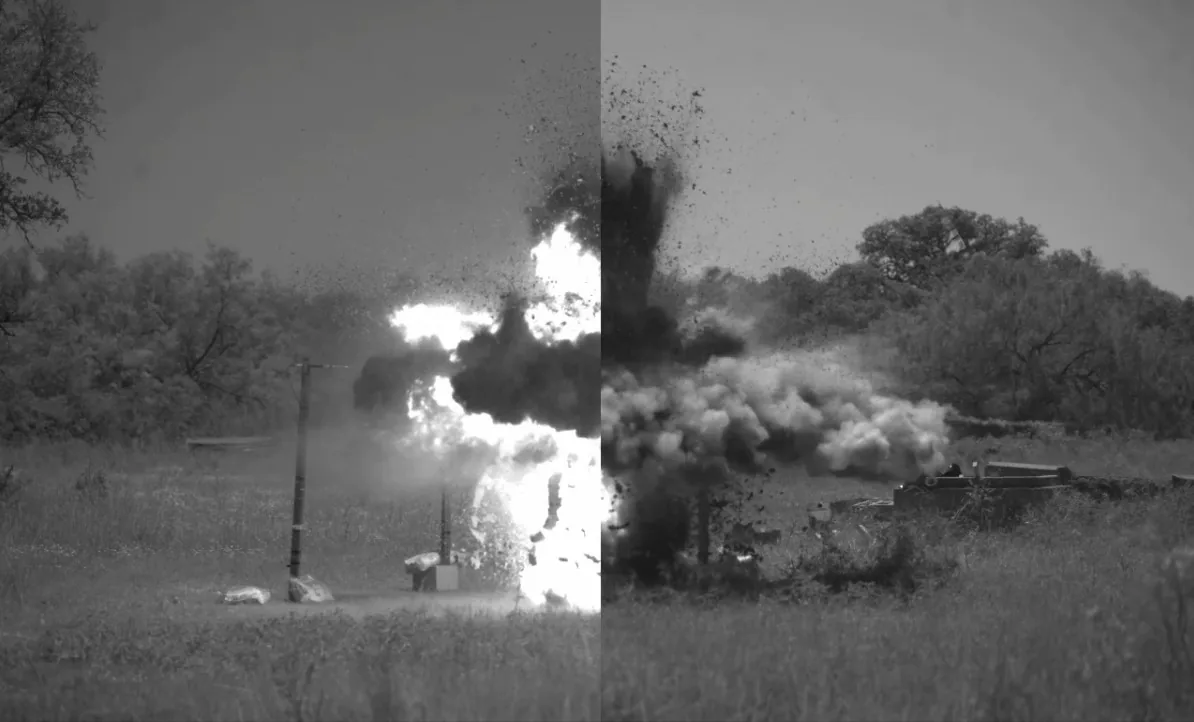
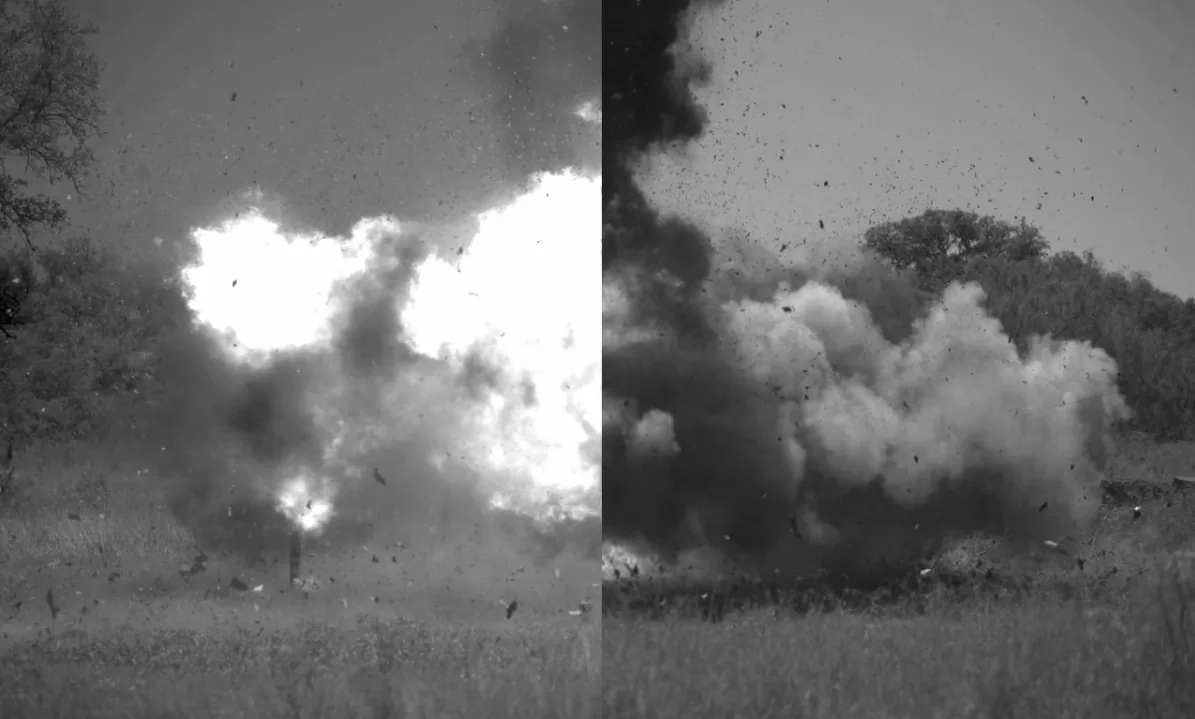
Blast mitigation without and with phase change materials
600 g C-4 charges. Split-screen high-speed frames: unmitigated on the left, FPS-protected boxes on the right.
Applications
Where to use it
Use FPS packaging products and containers for munitions transport and storage.
Use FPS panels and barriers for:
- Building interiors and tunnels
- Ship interiors
- Demilitarization and mine clearing
- Protection for tactical breaching operations
- VIP protection
- Protecting in-theater bases and checkpoints
What comes next
Future research and development
Modeling blast mitigation requires a much greater experimental database. Parametric relationships of particle and shock wave velocities, impulse and temperature reductions, as functions of blast intensity, media density and thickness, total media mass, specific surface and granular media characteristic dimensions (and dimension range), cannot be established without more experimental data.
The optimum thickness or placement of PCMs requires much more experimentation, since packed beds of any kind (sand, powdered PCMs, granular two-phase media) increase impulse and reflected shock parameters.
Experiments by Halsey and Berry* showed substantial reductions of fragment kinetic energy when cased munitions (bombs and projectiles) packed in granular pumice (another volcanic foamed glass) detonate. Experiments must be performed to quantify kinetic energy reductions and obtain quantified parametric data to model and design protection means.
*Halsey, C. C. and Berry, S. L., Expanding Pumice Technology to the Protection of Missile Warheads from Sympathetic Detonation. Paper presented at the DOD Explosives Safety Board Explosives Safety Seminar, Las Vegas, NV, 20 to 22 August 1996.
Presentation
Download the presentation
Blast effect reduction using mitigating media. Guy L. Gettle, Fireproof Solutions, Inc. Prepared for the International Ballistics Society symposium (ISB 2026).
The presentation covers the test setup, the 1996 UK Ministry of Defence DERA results and the 2024 to 2026 Southwest Research Institute results, with the supporting photographs.
Discuss a blast mitigation application
Tell us what you want to protect and the kind of space it is in. We reply by email within one business day.